.png)
Noetix Bumi Humanoid Robot: Tiers, Verified Prices and How to Order (2026)
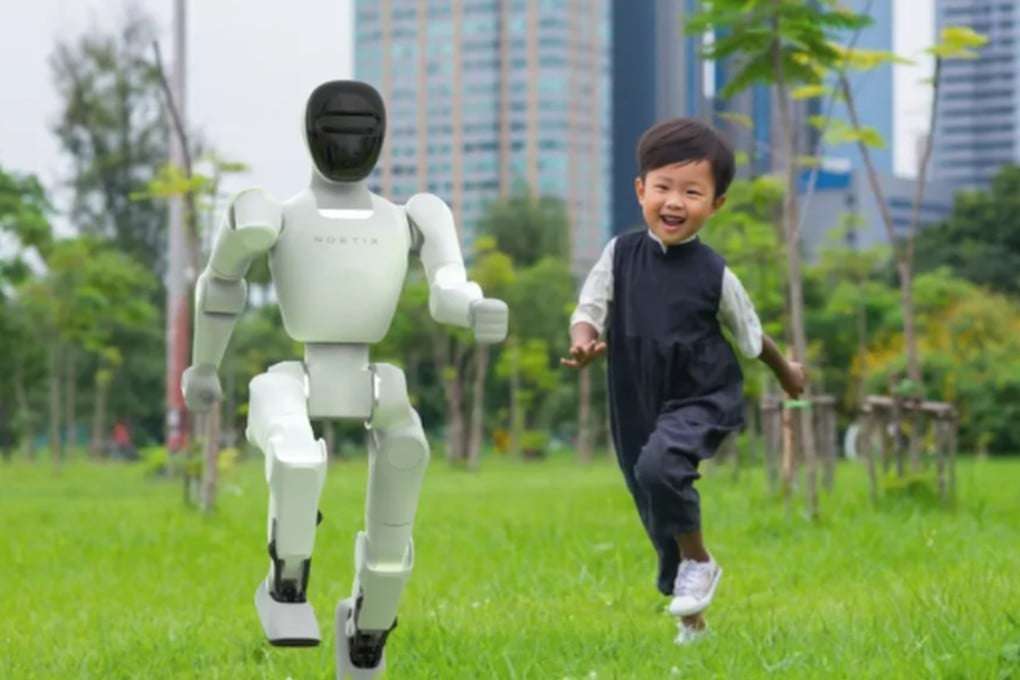
Noetix Bumi Humanoid Robot: Five Configurations, From $4,995
What is the Noetix Bumi and what does it cost? A 94 cm, 12 kg child-sized bipedal humanoid from Noetix Robotics, Beijing. Internationally it sells as five configurations from $4,995, all listed and orderable, verified September 7, 2026 — the ladder the buttons below open. The ¥9,998 (~$1,370) figure widely quoted is the China launch price, and needs a Chinese delivery address (verified September 6, 2026). The channel difference is explained below.
Configuration pages — one per buyable build, each with its own verified price, availability date and direct order link: Bumi PRO Compact — $4,995 · Bumi Standard — $5,995.
Bumi is a 94 cm, 12 kg bipedal humanoid built for classrooms and homes. Internationally it sells as a five-tier ladder — $4,995 to $14,995, every tier listed and orderable. The ¥9,998 (~$1,370) figure you may have seen quoted is the China-only launch price and needs a Chinese delivery address.
Education tiers run $8,995 / $9,995 / $14,995 — see the full ladder and order below, or request a quote for PO and multi-unit pricing.
Can you buy a Bumi outside the United States?
Yes — and it is the same order, not a different product. The dealer we route to sells internationally, and its own affiliate terms describe the territory as unrestricted. Every price on this page is quoted in US dollars, and that is the ladder our buy buttons open.
What changes outside the US is the currency you are quoted in, not the robot. Checked first-hand on September 8, 2026, the dealer runs separate regional storefronts for Canada, Europe, Latin America, Africa, Asia, Australia and the United States — the list it confirmed to us in writing that day. The Canadian and Australian storefronts quote in local currency, so the number on your checkout page will not match the USD figure here even when nothing about the price has changed. The European storefront lists Bumi without a US-dollar figure at all.
What we do and do not publish about that. We show the USD ladder because it is the one we re-read automatically every day. We deliberately do not publish local-currency prices for the regional storefronts: we do not machine-watch them, and a price nobody is watching goes stale without anyone noticing. If you are buying in another currency, ask for it in writing on a quote before you commit — the same rule we give institutional buyers about delivery terms.
Duty, import handling and local warranty terms are set by the dealer, not by us. They are quotable in writing, and a term does not exist until it is printed on your quote. Request a written quote →
What a Bumi Standard costs in each region
The robot is the same everywhere; the currency is not. These are the listed prices for the Bumi Standard on our dealer's regional storefronts, all read on the same day, September 8, 2026. We re-read them automatically every day, which is the only reason we publish them at all.
| Region | Currency | Listed price verified Sep 8, 2026 |
Notes |
|---|---|---|---|
| Main international storefront | USD | $5,995.00 | the ladder our buy buttons open |
| Europe | EUR | €5,309.12 | quoted in euros, no US-dollar figure shown |
| Canada | CAD | C$8,516.34 | quoted in Canadian dollars |
| Australia | AUD | A$8,555.57 | quoted in Australian dollars |
| Latin America | USD | $5,995.00 | same figure as the main storefront |
| Asia | USD | $5,995.00 | same figure as the main storefront |
| Africa | USD | $5,995.00 | same figure as the main storefront |
One gap worth knowing about. The dealer confirmed its regional storefronts to us in writing on September 8, 2026, and its US-specific storefront returned a not-found page for the Bumi when we checked on September 8, 2026. Whether that model is simply not assigned to that storefront is with their web team, so we report what we saw rather than why. The main international storefront does list it, and it is where our buy buttons go. We list a region above only where the dealer has confirmed the storefront is theirs and we can read the price ourselves.
The dealer states availability as “subject to availability” on its own listing and confirms it when the order is placed, so treat a listing as orderable rather than as stock reserved for you.
Read the differences carefully before you convert them in your head. A local-currency figure is not the same claim as a converted one: it can carry different tax treatment, different delivery terms and a different exchange rate on the day you pay. We publish what each storefront lists, not our own conversion of it, because a conversion would be our number rather than the seller's.
Our buy buttons all open the main international storefront, in US dollars, wherever you are reading from. That is deliberate and it is not a limitation of the dealer: it is the one channel where we can confirm our own referral is recorded. If you would rather order through your regional storefront, that is entirely fine — ask for the price in writing on a quote first. Request a written quote →
Breaking the Price Barrier in Consumer Robotics
In October 2025, Beijing-based startup Noetix Robotics unveiled Bumi, a humanoid robot that fundamentally challenges the economics of consumer robotics. Priced at ¥9,998 (approximately $1,370), Bumi represents the first high-performance bipedal humanoid robot available to consumers for less than the cost of a flagship smartphone. This pricing breakthrough positions Bumi as a catalyst for mass-market adoption of humanoid robotics technology previously confined to research laboratories and corporate R&D departments.
The launch comes at a pivotal moment in the broader humanoid robotics revolution, where manufacturers are racing to develop affordable platforms. While competitors like Unitree's H2 and Tesla Optimus focus on full-scale industrial capabilities, Noetix has carved out a distinct market position by targeting education and family entertainment. Unlike industrial-grade robots that can run well past $100,000, Bumi is designed specifically for classrooms, homes, and hobbyist developers.
Market Positioning: Bumi creates a new category in humanoid robotics—affordable enough for individual consumers and educational institutions, yet sophisticated enough to serve as a legitimate development platform. At 94 centimeters tall and weighing just 12 kilograms, the robot fits comfortably into real-world home and classroom environments.
The robot's market reception validates the pent-up demand for accessible humanoid technology. Noetix reported that over 100 units sold within the first hour of availability, with the first 500 units purchased within two days during China's major shopping festivals. This rapid sell-through demonstrates that a significant consumer segment has been waiting for humanoid robotics to reach smartphone price parity.
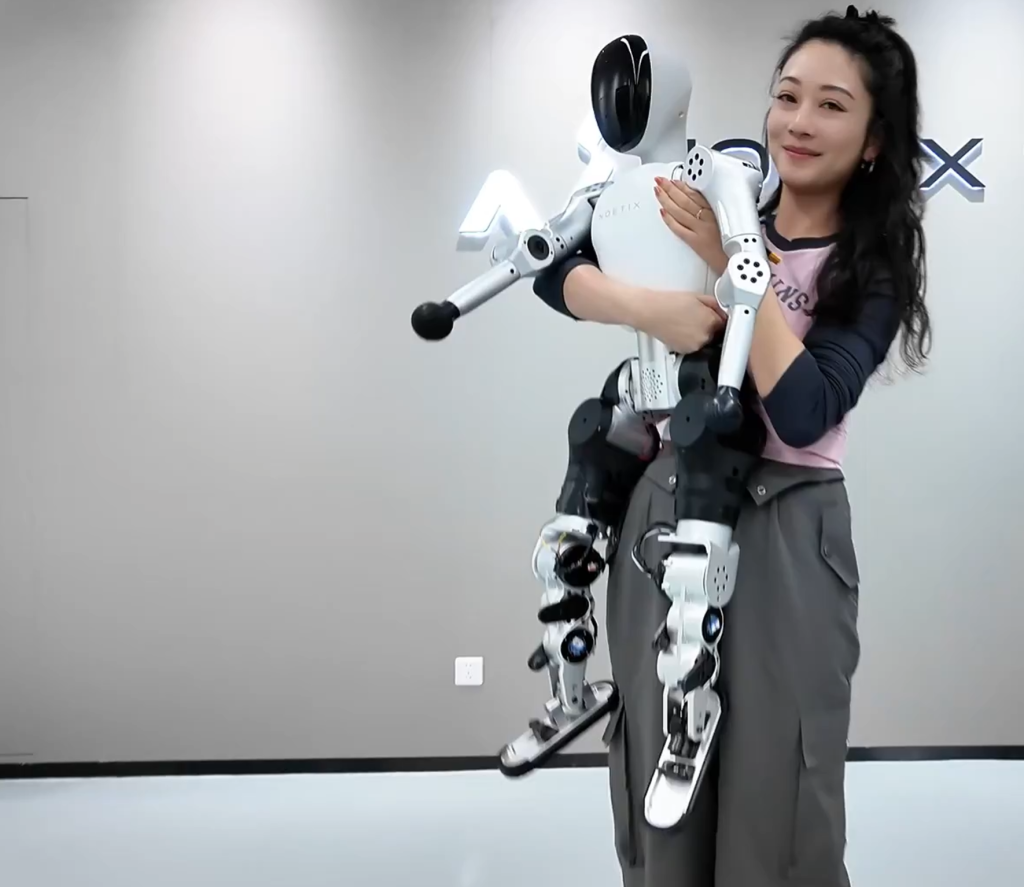
Held against an adult, the 94 cm and 12 kg on the spec sheet stop being abstract — this is the size that makes Bumi a classroom and living-room machine rather than a lab platform.
For organizations evaluating humanoid robot investments, Bumi's emergence signals a fundamental shift in the industry. The days of six-figure humanoid platforms serving as the only option are ending. Educational institutions, research labs, and companies exploring robotics initiatives now have access to affordable platforms suitable for proof-of-concept testing, employee training, and educational program development without the capital expenditure traditionally required.
Noetix's success with Bumi follows the company's viral moment in April 2025, when its larger N2 robot finished second in the world's first humanoid half-marathon in Beijing. That achievement—completing 21 kilometers in 3 hours and 37 minutes—generated over 2,500 pre-orders for the N2 and tripled the company's valuation. Bumi represents Noetix's strategic move to capture the mass-market segment that N2's launch price couldn't reach.
For a comprehensive overview of how Bumi fits into the broader humanoid robotics revolution, including comparisons with industrial platforms like Unitree H2 and Tesla Optimus, explore our detailed market analysis.
Noetix Robotics: From University Research to Commercial Success
Company Origins and Leadership
Noetix Robotics (officially Songyan Dynamics Beijing Technology Co., Ltd.) was founded in September 2023 by 27-year-old Jiang Zheyuan, who left his doctoral studies at Tsinghua University to commercialize humanoid robotics technology. The company's founding team comprises young engineers and researchers from China's top institutions, including Tsinghua University and Zhejiang University, bringing academic rigor to commercial product development.
Unlike many robotics startups that focus on showcase demonstrations and long-term research timelines, Jiang positioned Noetix for rapid commercialization from inception. In interviews, he explained that limited financial resources forced Noetix to prioritize early revenue generation over purely technical idealism. This pragmatic approach has proven successful, with the company achieving positive cash flow in Q4 2024.
Funding and Growth Trajectory
Noetix has completed five funding rounds since 2023, culminating in a Pre-B round of nearly ¥300 million (approximately $41 million) led by Vertex Ventures in October 2025. The company's valuation tripled following the viral success of its N2 robot at the Beijing humanoid half-marathon in April 2025, reaching a current valuation of approximately $200 million.
Manufacturing and Production Capacity
Noetix operates production facilities in Beijing and Changzhou, with a third manufacturing site in planning stages. The company aims to scale production to 1,000 units per month by late 2025, a target that reflects both growing demand and the efficiency gains from vertical integration. Current production capacity stands at approximately 10 robots per day, with plans to deliver around 2,000 total units by year-end 2025.
The company's manufacturing strategy leverages China's domestic supply chain advantages, with nearly 100 percent of components sourced locally. This localization strategy enables faster iteration cycles, reduces logistics costs, and provides Noetix with a significant cost advantage over international competitors who must manage complex global supply chains.
Product Portfolio Evolution
Before Bumi, Noetix developed the N2 humanoid robot, a 118cm tall, 29kg platform priced well above Bumi at launch. The N2 established Noetix's technical credentials through its marathon performance and competitive success, generating over 2,500 orders. The company also offers the E1, an upgraded N2 variant with enhanced capabilities.
Jiang has stated that Noetix plans to launch even more affordable consumer-grade robots priced around ¥5,000 ($700) in future product iterations, continuing the trend toward mass-market accessibility. This product strategy mirrors successful consumer electronics companies, with Jiang explicitly stating his vision for Noetix to become "the Xiaomi of the humanoid robot industry" in the short term and "the Apple of robotics" in the long term. For organizations tracking the broader landscape of humanoid robotics companies, Noetix represents a new model: rapid commercialization through cost engineering rather than technical maximalism.
Bumi Technical Specifications and Engineering Design
Core Hardware Specifications
Bumi's engineering reflects a calculated balance between capability and cost optimization. The robot's physical specifications position it as a child-sized platform designed to avoid intimidation while maintaining functional utility across educational and home environments.
| Height | 94 cm (3.1 feet) |
| Weight | 12 kg (26.5 lbs) |
| Degrees of Freedom | 21 joints |
| Battery | 48V, 3.5Ah+ capacity |
| Runtime | 1-2 hours per charge |
| Maximum Speed | Walking/running capable |
| Materials | Lightweight composite with metal reinforcement |
| Processor | Rockchip (domestically sourced) |
| Price | ¥9,998 (~$1,370 USD) China launch; $4,995–$14,995 international |
Motion Control and Mobility
Bumi incorporates 21 degrees of freedom distributed across its body, enabling coordinated bipedal locomotion and upper-body articulation. The joint configuration includes knee and elbow flexion, hip rotation for balance maintenance, and torso articulation for dynamic movement patterns. This DOF count positions Bumi below industrial humanoids like the Unitree H2 (31 DOF) but above basic educational robots, reflecting its consumer-focused design philosophy.
The robot employs Noetix's proprietary motion control system, developed in-house to optimize hardware-software integration. This self-developed control architecture enables smooth walking patterns, coordinated dance movements, and balance recovery—capabilities demonstrated publicly through marathon completion and competitive robotics events.
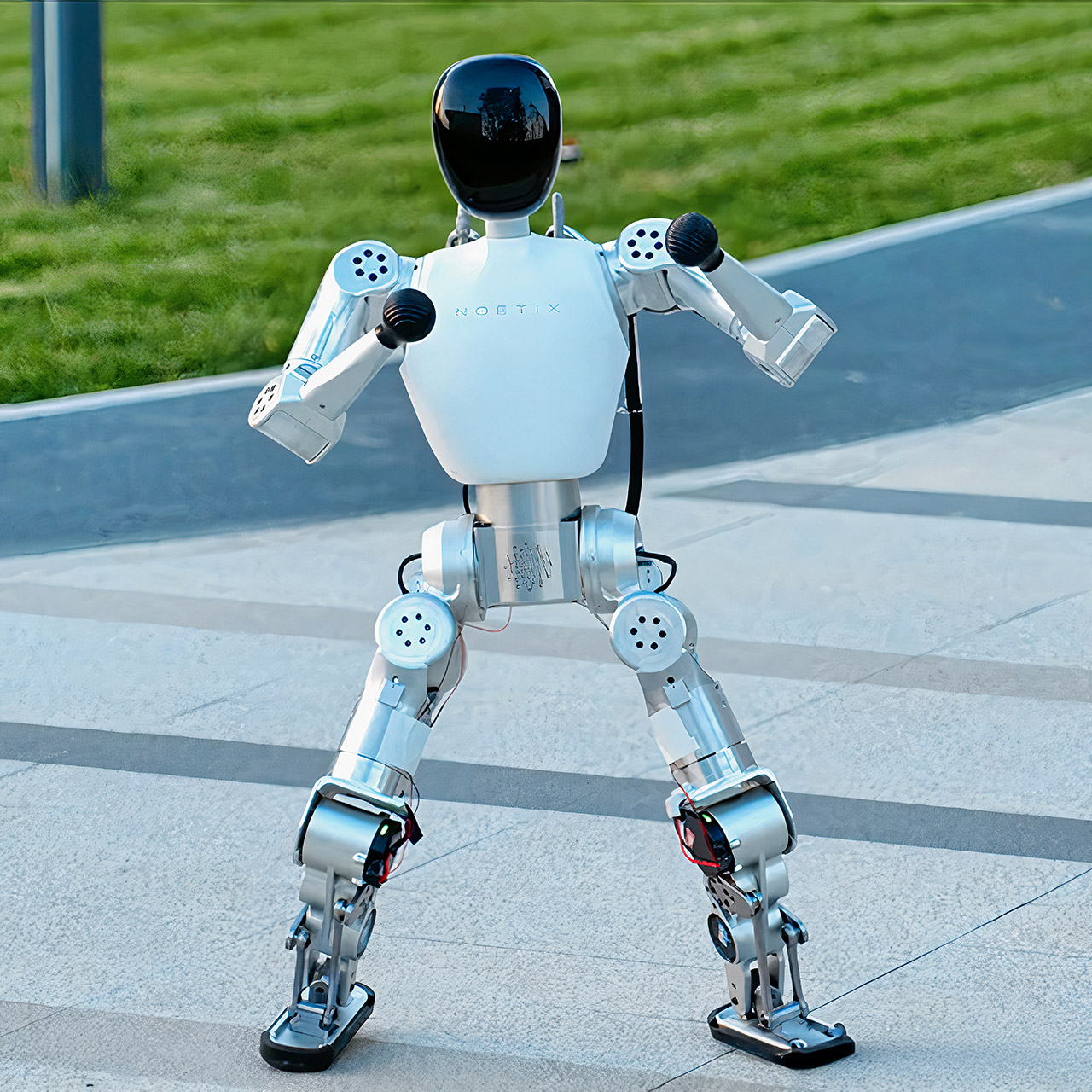
The 21 joints are visible from outside: knees, hips, shoulders and elbows each carry their own actuator, which is what a composite frame at 12 kg buys.
Sensor Array and Perception
Bumi integrates a front-mounted camera system for visual perception, enabling object detection and facial recognition capabilities. The vision system supports basic navigation assistance and human-robot interaction scenarios. Multiple microphones provide voice capture for command recognition and conversational interaction, positioning Bumi as both a physical robot and an interactive companion device.
The sensor configuration prioritizes cost efficiency over comprehensive environmental mapping. Unlike industrial humanoids that incorporate LIDAR and depth cameras, Bumi employs a simplified perception stack sufficient for supervised home and classroom use. This pragmatic approach reduces component costs while maintaining functional utility for intended use cases.
Movement Capabilities at a Glance
Power System and Battery Management
The 48-volt power system provides 1-2 hours of operational runtime depending on activity intensity. Walking and light interaction consume power conservatively, while dynamic movements like running or dancing drain the battery more rapidly. The battery remains user-replaceable, allowing for extended operation through battery swapping—a practical consideration for educational environments requiring continuous operation throughout school days.
Durability Considerations: Noetix states that Bumi's joints feature sealed construction for dust resistance, with modular component design enabling straightforward part replacement. However, the company has not published detailed durability testing results or ingress protection ratings. Commercial buyers should anticipate supervised operation requirements and avoid exposing units to harsh environmental conditions or liquids.
Materials Engineering and Weight Optimization
Bumi's 12-kilogram weight represents a deliberate engineering achievement. The robot employs lightweight composite materials as the primary structural framework, with metal reinforcement applied selectively only at high-stress joints and load-bearing locations. The weight reduction creates cascading cost benefits: lighter frames require less powerful actuators, smaller batteries reduce material costs, and the reduced overall component count simplifies assembly processes.
For detailed specifications of competing platforms, compare Bumi against the Unitree H2 (31 DOF, 180cm) and Unitree H1 in our interactive comparison tool.
How Noetix Achieved the ¥9,998 China Launch Price
Bumi's breakthrough pricing derives from systematic cost engineering across three fundamental pillars: vertical integration, structural redesign, and localized supply chains. Founder Jiang Zheyuan has explicitly outlined these strategies as the foundation for Noetix's competitive advantage.
Strategy 1: Vertical Integration of Critical Components
Strategy 2: Strategic Material Selection and Structural Redesign
Strategy 3: 100% Domestic Supply Chain Localization
Price Positioning in the Humanoid Market
Bumi's ¥9,998 (~$1,370) China launch price represented a 4-10x cost advantage over the next-cheapest functional humanoid platforms in that market. Compare Bumi's pricing using our interactive comparison tool:
| Robot Model | Price | Height | Target Market |
|---|---|---|---|
| Noetix Bumi | $4,995–$14,995 international ladder |
94cm | Education, Home |
| Noetix N2 | Not tracked | 118cm | Research, Education |
| Unitree R1 | From $8,990 | 121cm | Research, Development |
| Unitree H2 | From $39,900 | 180cm | Research, Industrial |
| Tesla Optimus | $20,000 (est.) | 173cm | Industrial |
Lightweight Construction Enables Cost Savings
Traditional humanoid robots employ metal frames throughout their structure for durability and industrial strength. Bumi inverts this paradigm by using lightweight composites as primary structural materials, applying metal reinforcement selectively only at high-stress joints. This materials strategy reduces Bumi's weight to 12 kilograms—significantly below competitors' 29-50kg platforms.
The lighter frame enables smaller motors, more compact batteries, and simplified thermal management. These cascading benefits compound: each weight reduction enables further cost optimization in adjacent systems. Where industrial robots require heavy-duty actuators capable of moving 40-50kg frames, Bumi's 12kg mass permits lighter, cheaper motor assemblies.
Economic Implications for Humanoid Robot Adoption
Bumi's pricing breakthrough has immediate implications for organizations evaluating humanoid robot procurement strategies. Educational institutions previously unable to justify five-figure robotics platforms can now access humanoid technology for the cost of a laptop cart. Corporate training programs can deploy multiple units for employee familiarization without capital expenditure justifications. Researchers and developers gain access to affordable hardware for algorithm testing and motion control experimentation.
Cost Engineering vs. Feature Compromise: Founder Jiang Zheyuan has stated that Bumi's pricing is not "malicious competition" but rather reflects the industry's inevitable trajectory toward affordability. By targeting educational and entertainment use cases rather than industrial load-bearing or autonomous household labor, Noetix sidesteps expensive capabilities unnecessary for their market segment.
The ¥9,998 (~$1,370) China launch price positions humanoid robots alongside consumer electronics rather than industrial equipment. This category shift changes purchasing dynamics: robots move from multi-year capital planning cycles to departmental budgets and individual purchases. The psychological barrier of five-figure investments disappears, enabling impulse purchases during promotional periods.
For Western robotics companies, Bumi's cost engineering raises competitive pressure to match Chinese manufacturing efficiency or differentiate through capabilities that justify premium pricing. The days of maintaining 10-20x price premiums through brand positioning alone appear to be ending. Explore how other manufacturers are responding in our humanoid robotics company directory.
Bumi Programming Interfaces and Software Ecosystem
Noetix positions Bumi as an open development platform rather than a closed consumer appliance. The robot's software architecture prioritizes accessibility for novice programmers while providing sufficient flexibility for advanced users to explore custom behaviors and motion sequences. This dual-tier approach makes Bumi suitable for K-12 education, university research, and hobbyist development communities.
Graphical Programming for Beginners
Bumi supports drag-and-drop graphical programming interfaces designed specifically for children and first-time coders. This visual programming paradigm follows patterns established by educational platforms like Scratch and Blockly, where users construct programs by connecting logical blocks rather than writing text-based code. Students can create sequences of movements, define conditional behaviors, establish loops for repeated actions, and set up reactions to voice commands or visual stimuli.
Open Programming Interfaces for Developers
Beyond the beginner-friendly graphical layer, Bumi provides open programming interfaces for developers seeking low-level control. While Noetix has not published comprehensive API documentation publicly, the company's emphasis on openness suggests access to motion control primitives, sensor data streams, and hardware interfaces necessary for research and advanced development.
This openness positions Bumi as a legitimate development platform for university robotics programs, hobbyist makers, and independent researchers who need affordable hardware for testing motion control algorithms, machine learning models, or human-robot interaction paradigms. At its ¥9,998 (~$1,370) China launch price, Bumi becomes accessible to graduate students conducting thesis research and individual developers experimenting with bipedal locomotion.
Educational Use Cases and Classroom Applications
Bumi Target Applications and Market Positioning
Noetix has explicitly positioned Bumi for education and family entertainment rather than autonomous household labor or industrial work. This market focus represents a strategic decision to avoid competition with established industrial humanoid manufacturers while serving underaddressed segments where price sensitivity creates significant barriers to adoption.
Educational institutions represent Bumi's core addressable market. The ¥9,998 (~$1,370) China launch price makes humanoid robotics accessible to schools and universities previously unable to justify five-figure platform costs.
Researchers studying bipedal locomotion, human-robot interaction, or motion control algorithms gain access to affordable hardware for experimentation. At the China launch price, individual graduate students can purchase personal development units, while labs can deploy multiple robots for statistically significant sample sizes in HRI studies.
Bumi's smartphone-equivalent pricing enables individual consumer purchases previously limited to institutional buyers. Tech hobbyists can experiment with humanoid robotics without multi-thousand-dollar investments, while families can access educational entertainment that combines play with STEM skill development.
Important Deployment Considerations: Noetix explicitly positions Bumi as NOT suitable for industrial labor, autonomous household task completion, or elder care applications. The robot lacks manipulation capabilities, payload capacity, and autonomy levels required for practical work scenarios. Organizations evaluating industrial humanoid platforms should consider Unitree H2, Tesla Optimus, or 1X NEO instead.
Bumi occupies a unique position in the humanoid market taxonomy. It sits below research-grade platforms like the Unitree H1 but above toy-grade bipedal robots ($100-300) that lack meaningful programmability. This middle ground creates a new category: affordable development platforms suitable for serious learning without requiring institutional budgets.
Bumi vs. Competing Humanoid Robots
Bumi's market positioning becomes clearer when evaluated against competing humanoid platforms. Use our interactive comparison tool to explore detailed specifications across 50+ robots:
| Robot | Price | Height | DOF | Target Use |
|---|---|---|---|---|
| Noetix Bumi | $4,995–$14,995 international ladder |
94cm | 21 | Education, Home |
| Noetix N2 | Not tracked | 118cm | 29 | Research, Education |
| Unitree R1 | From $8,990 | 121cm | 20–26 | Research |
| Unitree H2 | From $39,900 | 180cm | 31 | Industrial |
| Unitree G1 | $17,990 | 127cm | 23-43 | Research, Development |
| 1X NEO | TBD | 165cm | 20+ | Household |
| Tesla Optimus | Not for sale | 173cm | 40+ | Industrial |
| Booster T1 | From $29,800 (in stock, verified Sept 7, 2026) | 118cm | 23–41 | Research / commercial |
When to Choose Bumi Over Industrial Humanoids
Choose Bumi when: Educational institutions prioritizing affordability and multi-unit deployment benefit from Bumi's 4-10x lower cost. The child-safe form factor suits K-12 environments better than full-scale robots. Hobbyists and individual developers gain affordable access to functional humanoid hardware.
Choose industrial humanoids when: Research requires adult-sized platforms, advanced manipulation capabilities, heavy payload capacity, or autonomous task completion. Industrial applications demand durability, precision, and performance that justify higher price points.
Key Differentiators
Price advantage: At its ¥9,998 (~$1,370) China launch price, Bumi costs 4-10x less than competing functional humanoids. This enables educational institutions to purchase classroom sets rather than single demonstration units.
Size trade-off: Bumi's 94cm height limits its applications compared to full-scale humanoids, but creates advantages in child-friendly environments where smaller robots feel less intimidating.
Capability positioning: Bumi targets education and entertainment rather than industrial work. Organizations needing robots for physical labor, household tasks, or warehouse operations should evaluate Unitree H2, Tesla Optimus, or 1X NEO instead.
Organizations comparing options should consult our comprehensive robot vendor directory for purchasing guidance across manufacturers.
Compare All 50+ Humanoid Robots →How to Buy Noetix Bumi: Two Ways to Order
Bumi now has two purchase channels. The China-direct channel carries the launch price of ¥9,998 (~$1,370 USD) but requires a Chinese delivery address. For everyone else, an international robotics dealer now stocks the full Bumi line with online checkout — at international-dealer pricing that includes export handling, across a wider configuration ladder than the China launch SKU.
🛒 Order Bumi Now — International Checkout
All five configurations listed and orderable, subject to availability. Prices read from the dealer's live product pages on September 7, 2026; the dealer's checkout shows the final price.
| Configuration | Price (USD) | |
|---|---|---|
| Bumi PRO Compact | $4,995 | Buy → |
| Bumi Standard | $5,995 | Buy → |
| Bumi EDU PRO | $8,995 | Buy → |
| Bumi EDU | $9,995 | Buy → |
| Bumi EDU MAX | $14,995 | Buy → |
Checkout completes at our partner dealer — you leave BotInfo to finish the order. Every tier above is listed and orderable; the dealer confirms availability at checkout, and no discount code is needed. Ordering, payment, logistics, and after-sales are handled by the dealer. Buying through these links supports BotInfo at no extra cost — see our affiliate disclosure.
Prefer a formal quote, purchase order, or multi-unit education pricing? Request a quote from our desk →
China-Direct Channel: Launch Pricing and Details
Current Availability and Pricing
Noetix launched Bumi pre-sales in October 2025, strategically timed to coincide with China's major shopping festivals—Double 11 (Singles' Day, November 11) and Double 12 (December 12). These e-commerce events represent China's equivalent to Black Friday and Cyber Monday, generating peak consumer attention and purchasing activity.
Bumi Purchase Details
International Ordering Considerations
Noetix itself has not announced official international distribution channels — its direct channels remain China-focused, where manufacturing proximity, cultural familiarity, and e-commerce infrastructure provide operational advantages. Since September 2026, however, the full Bumi line can be ordered internationally through a dealer channel with online checkout (see the order options above), which removes the Chinese-address requirement of the domestic route.
International Buyer Challenges: Organizations outside China face multiple barriers including Chinese address requirements for domestic delivery, language barriers in documentation, and 48V power system voltage adaptation needs. Import duties, shipping logistics, and warranty support remain unclear for international buyers.
Alternative Options for International Buyers
International buyers no longer need workarounds: the dealer channel above carries the full configuration ladder with standard online checkout. The remaining alternatives — contacting Noetix Robotics directly about export availability and institutional bulk purchasing, or third-party forwarding services (which typically add 15–30% to product value) — mainly matter for buyers who specifically want the China-market SKU at the China launch price.
What's Included with Bumi Purchase
While Noetix has not published comprehensive unboxing inventories, standard robotics platform purchases typically include the fully assembled robot unit, 48V rechargeable battery (3.5Ah+), charging equipment with power adapter, user manual and quick start guide (likely in Chinese), and software access for programming interface downloads.
⚡ Bumi Is Orderable Now — And So Are These
Bumi can be ordered today through the checkout links above. If you need a larger research-grade humanoid, these platforms are also available now:
• Unitree R1 (from $8,990) - Full-scale research platform
• Unitree G1 (from $17,990) - Advanced development humanoid
Alternatives to Consider
Organizations evaluating Bumi should simultaneously research alternative platforms to ensure informed purchasing decisions. For educational buyers, compare Bumi against traditional educational robotics platforms and newer humanoid options like the Unitree R1 from $8,990 for advanced university programs. For research organizations, assess whether Bumi's specifications meet requirements or if full-scale platforms like Unitree H2 provide necessary capabilities for precise force control and heavy payloads.
Questions About Ordering Bumi?
Bumi is orderable now through the checkout links above. Use this form for purchasing questions, education/multi-unit inquiries, or product updates — or request a formal quote.


