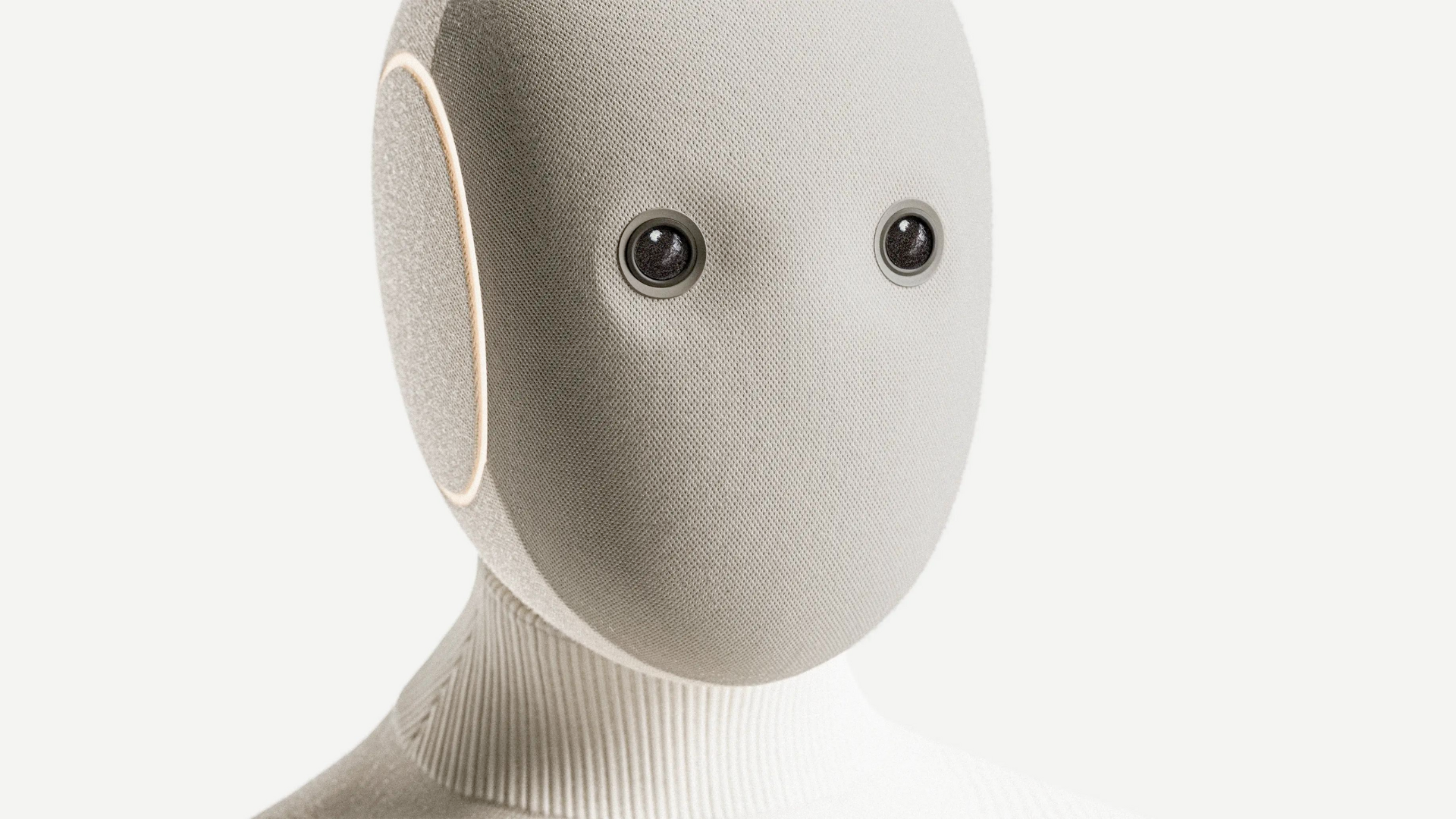
The 1X NEO represents the first consumer humanoid robot designed specifically for home environments. Developed by Norwegian robotics company 1X Technologies with backing from OpenAI, NEO aims to bring practical robotic assistance into everyday households starting in 2026.
This comprehensive guide covers everything prospective buyers need to know: technical specifications, realistic capability expectations, the teleoperation model that makes early deployment possible, pricing and pre-order details, and how NEO compares to alternatives like Tesla Optimus and Unitree G1.
Unlike industrial robots adapted for consumers, NEO was engineered from the ground up for residential environments. Human-proportioned dimensions allow natural navigation through doorways, stairs, and furniture layouts.
Strategic investment from OpenAI provides NEO with advanced language understanding and reasoning capabilities. The partnership accelerates AI development through access to cutting-edge multimodal models.
NEO uses human teleoperators to handle complex tasks the AI can't yet manage autonomously. This hybrid approach enables useful functionality from day one while the AI continuously improves.
NEO is not a fully autonomous household helper in 2026. Buyers should expect a capable but developing platform that requires teleoperator support for complex tasks.
See the 1X NEO humanoid robot performing real-world tasks. These demonstrations showcase NEO's current capabilities including kitchen assistance, object manipulation, and household navigation.
Celebrity chef Nick DiGiovanni demonstrates cooking alongside the 1X NEO robot, showcasing real-world kitchen assistance and human-robot collaboration.
Official 1X Technologies demonstration of NEO learning to clean, organize items, and navigate home environments through AI training.
These videos represent NEO's capabilities during controlled demonstrations. Real-world performance may vary based on environment complexity and available teleoperation support.
The NEO Home Robot represents 1X Technologies' transition from research prototypes to consumer-ready hardware. Below are the complete technical specifications for the consumer version now available for pre-order.
| Specification | Details | Notes |
|---|---|---|
| Height | 165 cm (5'5") | Optimized for human environments |
| Weight | 30 kg (66 lbs) | Lightweight composite materials |
| Actuation | Tendon-driven | Compliant, safe for humans |
| Hand Dexterity | 22 DOF per hand | Human-level manipulation |
| Lift Capacity | 70 kg (154 lbs) | Single-arm maximum |
| Carry Capacity | 25 kg (55 lbs) | Sustained carrying |
| Vision System | 2× 8MP fisheye | 180° FOV per eye |
| AI Model | Redwood (160M) | Vision-language-action |
| Battery Life | 4 hours active | Auto-recharging |
| Price (Purchase) | $20,000 | Full ownership |
| Price (Lease) | $499/month | 6-month minimum |
| Availability | Pre-order now | Ships Q3 2026, US priority |
The NEO Home Robot represents a fundamental departure from conventional humanoid robot design philosophy. While competitors like Boston Dynamics prioritize athletic performance, Tesla focuses on manufacturing cost reduction, and Figure AI targets industrial productivity, 1X Technologies built NEO specifically for safe, useful interaction in human homes.
Tendon-driven actuators provide inherent compliance—if NEO contacts a human, the system yields rather than resists. Unlike rigid motor-driven joints, NEO's tendons mimic biological muscle structure.
At 165 cm and 30 kg, NEO is sized for residential spaces. It navigates standard doorways, reaches countertops, and operates in human-proportioned environments without modifications.
With 22 degrees of freedom per hand, NEO manipulates everyday objects—opening doors, handling delicate items, using human tools—without specialized robotic tooling.
| Characteristic | Tendon-Drive (NEO) | Traditional Motors |
|---|---|---|
| Safety | ✓ Inherently compliant | Rigid, requires active control |
| Weight | ✓ Motors in torso, lighter limbs | Heavy motors at each joint |
| Impact | ✓ Yields on contact | Must sense and react |
| Efficiency | ✓ Passive storage in tendons | Active power required |
The OpenAI partnership positions NEO for continuous improvement. As OpenAI develops more advanced multimodal models, 1X can deploy updated AI capabilities through over-the-air software updates—similar to how Tesla improves Autopilot without hardware changes.
NEO walks at human pace (~1.2 m/s) versus industrial robots reaching 3+ m/s. Prioritizes predictability and safety over speed.
25 kg sustained carry capacity versus 50+ kg for industrial models. Sufficient for household items but not warehouse pallets.
4-hour battery life versus 8+ hours for industrial platforms. Requires recharging mid-day for extended use.
| Walking Speed | ~1.2-1.5 m/s | Human walking pace |
| Stair Climbing | Standard stairs | Up to 20 cm step |
| Turning | In-place rotation | Tight navigation |
| Doorway | 80 cm (32") doors | All residential |
Key Differentiator: NEO's 22-degree-of-freedom hands represent human-level dexterity—more sophisticated than most industrial humanoids which typically employ 3-5 DOF grippers.
| Hand DOF | 22 per hand | Individual finger control |
| Grip Force (Max) | ~50 N per finger | Household objects |
| Grip Force (Safe) | ~20 N limited | Won't crush items |
| Object Range | 1-30 cm diameter | Keys to bottles |
| Vision | 2× 8MP fisheye | 180° FOV per eye |
| Depth | Stereo vision | No LiDAR needed |
| Audio | 4× 360° mics | Spatial audio |
| Tactile | Force feedback | Delicate handling |
| Battery | Lithium-ion | Integrated |
| Runtime | 4 hours typical | Varies by activity |
| Charging | ~2 hours | Auto-docking |
| Power Draw | ~200-300W | Active use |
Safety Priority: All specifications prioritize safe human interaction over maximum performance. NEO is designed to operate safely around children, elderly individuals, and pets.
Fully assembled
Auto-docking
iOS & Android
+ OTA updates
Understanding NEO's development history provides context for where the technology stands today and realistic expectations for 2026 capabilities.
Initial research prototype. Proof of concept for tendon-driven actuation and bipedal locomotion in home environments.
Second-generation prototype. Teleoperation data collection begins. OpenAI partnership announced. Manufacturing refinements.
Pre-orders open October 2025. Final consumer design locked. Mass production preparation begins.
Consumer shipments begin Q3-Q4 2026. US and Canada priority. Continuous AI improvements via OTA updates.
This is the most important thing to understand before buying NEO: The robot is not fully autonomous in 2026. NEO uses a hybrid model where human teleoperators remotely assist with complex tasks the AI cannot yet handle independently.
When NEO encounters a task it cannot complete autonomously, it requests help from 1X's "Expert Mode" service. A trained human operator takes remote control, completes the task, and the interaction becomes training data for NEO's AI. This service is included in your purchase/subscription.
| Year | Expected Autonomy | Teleoperation Role |
|---|---|---|
| 2026 | ~30% of tasks | Primary capability |
| 2027 | ~50% of tasks | Complex tasks only |
| 2028 | ~70% of tasks | Edge cases |
| 2029+ | ~90%+ of tasks | Rare exceptions |
| Pre-Orders Open | October 2025 |
| First Deliveries (US) | Q3 2026 |
| Canada Expansion | Q4 2026 |
| International | 2027 |
| Feature | 1X NEO | Tesla Optimus | Unitree G1 |
|---|---|---|---|
| Target Market | Consumer/Home | Industrial → Consumer | Research/Dev |
| Price | $20,000 | ~$20-30K* | $16,000 |
| Availability | Q3 2026 | TBD | Now |
| Height / Weight | 5'5" / 66 lbs | 5'8" / 125 lbs | 4'3" / 77 lbs |
| Teleoperation | Yes (Included) | Unknown | No |
| AI Partner | OpenAI | Tesla FSD | Open Platform |
*Tesla Optimus pricing estimated; consumer availability unconfirmed.
NEO is the only consumer-focused humanoid shipping to homes in 2026. Tesla Optimus may dominate through manufacturing scale eventually, but isn't confirmed for consumers. Unitree G1 targets developers, not households.
NEO is available exclusively through 1X Technologies' official website. Pre-orders require a $100 refundable deposit.
Pre-Order NEO →Fully refundable if you change your mind before shipping.
1X will evaluate your home setup for compatibility.
Pay remaining balance before shipping (~Q3 2026).
Professional installation and training included.
If you need a humanoid robot immediately for research or development, the Unitree G1 is shipping now. While not designed for home use, it offers an open development platform.
Read our Unitree G1 Complete Guide →If $20K is outside your budget, quadruped robots like the Unitree Go2 offer impressive capabilities starting at $1,600. Great for learning robotics fundamentals.
Explore Unitree Go2 Options →
1X Technologies has outlined their development priorities for NEO beyond the initial 2026 launch. Understanding this roadmap helps set realistic expectations for capability evolution.
| Timeline | Expected Capabilities |
|---|---|
| Q3 2026 | First consumer shipments, basic autonomous tasks, full teleoperation support |
| Q4 2026 | Expanded autonomous capabilities via OTA updates, reduced teleoperation needs |
| 2027 | International expansion, improved dexterity, longer battery life models |
| 2028+ | Near-full autonomy for routine tasks, specialized skill packages |
This roadmap reflects 1X Technologies' stated goals as of late 2025. Actual capabilities and timelines may vary based on AI development progress and real-world performance data.
Join the waitlist with a $100 refundable deposit. Shipping begins Q3 2026.
Pre-Order NEO for $20,000 →Get answers to the most common questions about the 1X NEO humanoid robot, including pricing, availability, capabilities, and comparisons.
Have more questions? Visit the official 1X Technologies NEO page or explore our Complete Robot Buyer's Guide.

The 1X NEO represents the first consumer humanoid robot designed specifically for home environments. Developed by Norwegian robotics company 1X Technologies with backing from OpenAI, NEO aims to bring practical robotic assistance into everyday households starting in 2026.
This comprehensive guide covers everything prospective buyers need to know: technical specifications, realistic capability expectations, the teleoperation model that makes early deployment possible, pricing and pre-order details, and how NEO compares to alternatives like Tesla Optimus and Unitree G1.
Unlike industrial robots adapted for consumers, NEO was engineered from the ground up for residential environments. Human-proportioned dimensions allow natural navigation through doorways, stairs, and furniture layouts.
Strategic investment from OpenAI provides NEO with advanced language understanding and reasoning capabilities. The partnership accelerates AI development through access to cutting-edge multimodal models.
NEO uses human teleoperators to handle complex tasks the AI can't yet manage autonomously. This hybrid approach enables useful functionality from day one while the AI continuously improves.
NEO is not a fully autonomous household helper in 2026. Buyers should expect a capable but developing platform that requires teleoperator support for complex tasks.
See the 1X NEO humanoid robot performing real-world tasks. These demonstrations showcase NEO's current capabilities including kitchen assistance, object manipulation, and household navigation.
Celebrity chef Nick DiGiovanni demonstrates cooking alongside the 1X NEO robot, showcasing real-world kitchen assistance and human-robot collaboration.
Official 1X Technologies demonstration of NEO learning to clean, organize items, and navigate home environments through AI training.
These videos represent NEO's capabilities during controlled demonstrations. Real-world performance may vary based on environment complexity and available teleoperation support.
The NEO Home Robot represents 1X Technologies' transition from research prototypes to consumer-ready hardware. Below are the complete technical specifications for the consumer version now available for pre-order.
| Specification | Details | Notes |
|---|---|---|
| Height | 165 cm (5'5") | Optimized for human environments |
| Weight | 30 kg (66 lbs) | Lightweight composite materials |
| Actuation | Tendon-driven | Compliant, safe for humans |
| Hand Dexterity | 22 DOF per hand | Human-level manipulation |
| Lift Capacity | 70 kg (154 lbs) | Single-arm maximum |
| Carry Capacity | 25 kg (55 lbs) | Sustained carrying |
| Vision System | 2× 8MP fisheye | 180° FOV per eye |
| AI Model | Redwood (160M) | Vision-language-action |
| Battery Life | 4 hours active | Auto-recharging |
| Price (Purchase) | $20,000 | Full ownership |
| Price (Lease) | $499/month | 6-month minimum |
| Availability | Pre-order now | Ships Q3 2026, US priority |
The NEO Home Robot represents a fundamental departure from conventional humanoid robot design philosophy. While competitors like Boston Dynamics prioritize athletic performance, Tesla focuses on manufacturing cost reduction, and Figure AI targets industrial productivity, 1X Technologies built NEO specifically for safe, useful interaction in human homes.
Tendon-driven actuators provide inherent compliance—if NEO contacts a human, the system yields rather than resists. Unlike rigid motor-driven joints, NEO's tendons mimic biological muscle structure.
At 165 cm and 30 kg, NEO is sized for residential spaces. It navigates standard doorways, reaches countertops, and operates in human-proportioned environments without modifications.
With 22 degrees of freedom per hand, NEO manipulates everyday objects—opening doors, handling delicate items, using human tools—without specialized robotic tooling.
| Characteristic | Tendon-Drive (NEO) | Traditional Motors |
|---|---|---|
| Safety | ✓ Inherently compliant | Rigid, requires active control |
| Weight | ✓ Motors in torso, lighter limbs | Heavy motors at each joint |
| Impact | ✓ Yields on contact | Must sense and react |
| Efficiency | ✓ Passive storage in tendons | Active power required |
The OpenAI partnership positions NEO for continuous improvement. As OpenAI develops more advanced multimodal models, 1X can deploy updated AI capabilities through over-the-air software updates—similar to how Tesla improves Autopilot without hardware changes.
NEO walks at human pace (~1.2 m/s) versus industrial robots reaching 3+ m/s. Prioritizes predictability and safety over speed.
25 kg sustained carry capacity versus 50+ kg for industrial models. Sufficient for household items but not warehouse pallets.
4-hour battery life versus 8+ hours for industrial platforms. Requires recharging mid-day for extended use.
| Walking Speed | ~1.2-1.5 m/s | Human walking pace |
| Stair Climbing | Standard stairs | Up to 20 cm step |
| Turning | In-place rotation | Tight navigation |
| Doorway | 80 cm (32") doors | All residential |
Key Differentiator: NEO's 22-degree-of-freedom hands represent human-level dexterity—more sophisticated than most industrial humanoids which typically employ 3-5 DOF grippers.
| Hand DOF | 22 per hand | Individual finger control |
| Grip Force (Max) | ~50 N per finger | Household objects |
| Grip Force (Safe) | ~20 N limited | Won't crush items |
| Object Range | 1-30 cm diameter | Keys to bottles |
| Vision | 2× 8MP fisheye | 180° FOV per eye |
| Depth | Stereo vision | No LiDAR needed |
| Audio | 4× 360° mics | Spatial audio |
| Tactile | Force feedback | Delicate handling |
| Battery | Lithium-ion | Integrated |
| Runtime | 4 hours typical | Varies by activity |
| Charging | ~2 hours | Auto-docking |
| Power Draw | ~200-300W | Active use |
Safety Priority: All specifications prioritize safe human interaction over maximum performance. NEO is designed to operate safely around children, elderly individuals, and pets.
Fully assembled
Auto-docking
iOS & Android
+ OTA updates
Understanding NEO's development history provides context for where the technology stands today and realistic expectations for 2026 capabilities.
Initial research prototype. Proof of concept for tendon-driven actuation and bipedal locomotion in home environments.
Second-generation prototype. Teleoperation data collection begins. OpenAI partnership announced. Manufacturing refinements.
Pre-orders open October 2025. Final consumer design locked. Mass production preparation begins.
Consumer shipments begin Q3-Q4 2026. US and Canada priority. Continuous AI improvements via OTA updates.
This is the most important thing to understand before buying NEO: The robot is not fully autonomous in 2026. NEO uses a hybrid model where human teleoperators remotely assist with complex tasks the AI cannot yet handle independently.
When NEO encounters a task it cannot complete autonomously, it requests help from 1X's "Expert Mode" service. A trained human operator takes remote control, completes the task, and the interaction becomes training data for NEO's AI. This service is included in your purchase/subscription.
| Year | Expected Autonomy | Teleoperation Role |
|---|---|---|
| 2026 | ~30% of tasks | Primary capability |
| 2027 | ~50% of tasks | Complex tasks only |
| 2028 | ~70% of tasks | Edge cases |
| 2029+ | ~90%+ of tasks | Rare exceptions |
| Pre-Orders Open | October 2025 |
| First Deliveries (US) | Q3 2026 |
| Canada Expansion | Q4 2026 |
| International | 2027 |
| Feature | 1X NEO | Tesla Optimus | Unitree G1 |
|---|---|---|---|
| Target Market | Consumer/Home | Industrial → Consumer | Research/Dev |
| Price | $20,000 | ~$20-30K* | $16,000 |
| Availability | Q3 2026 | TBD | Now |
| Height / Weight | 5'5" / 66 lbs | 5'8" / 125 lbs | 4'3" / 77 lbs |
| Teleoperation | Yes (Included) | Unknown | No |
| AI Partner | OpenAI | Tesla FSD | Open Platform |
*Tesla Optimus pricing estimated; consumer availability unconfirmed.
NEO is the only consumer-focused humanoid shipping to homes in 2026. Tesla Optimus may dominate through manufacturing scale eventually, but isn't confirmed for consumers. Unitree G1 targets developers, not households.
NEO is available exclusively through 1X Technologies' official website. Pre-orders require a $100 refundable deposit.
Pre-Order NEO →Fully refundable if you change your mind before shipping.
1X will evaluate your home setup for compatibility.
Pay remaining balance before shipping (~Q3 2026).
Professional installation and training included.
If you need a humanoid robot immediately for research or development, the Unitree G1 is shipping now. While not designed for home use, it offers an open development platform.
Read our Unitree G1 Complete Guide →If $20K is outside your budget, quadruped robots like the Unitree Go2 offer impressive capabilities starting at $1,600. Great for learning robotics fundamentals.
Explore Unitree Go2 Options →
1X Technologies has outlined their development priorities for NEO beyond the initial 2026 launch. Understanding this roadmap helps set realistic expectations for capability evolution.
| Timeline | Expected Capabilities |
|---|---|
| Q3 2026 | First consumer shipments, basic autonomous tasks, full teleoperation support |
| Q4 2026 | Expanded autonomous capabilities via OTA updates, reduced teleoperation needs |
| 2027 | International expansion, improved dexterity, longer battery life models |
| 2028+ | Near-full autonomy for routine tasks, specialized skill packages |
This roadmap reflects 1X Technologies' stated goals as of late 2025. Actual capabilities and timelines may vary based on AI development progress and real-world performance data.
Join the waitlist with a $100 refundable deposit. Shipping begins Q3 2026.
Pre-Order NEO for $20,000 →Get answers to the most common questions about the 1X NEO humanoid robot, including pricing, availability, capabilities, and comparisons.
Have more questions? Visit the official 1X Technologies NEO page or explore our Complete Robot Buyer's Guide.